Self-paced course
Build real Japanese foundations —
not a pile of memorized phrases.
19 video lessons that take you from the alphabet to building your own sentences. Learn why Japanese works the way it does, so you can use it — not just recognize it.
Enrollment isn’t open yet. $99 · One-time payment · Yours forever · 14-day money-back guarantee
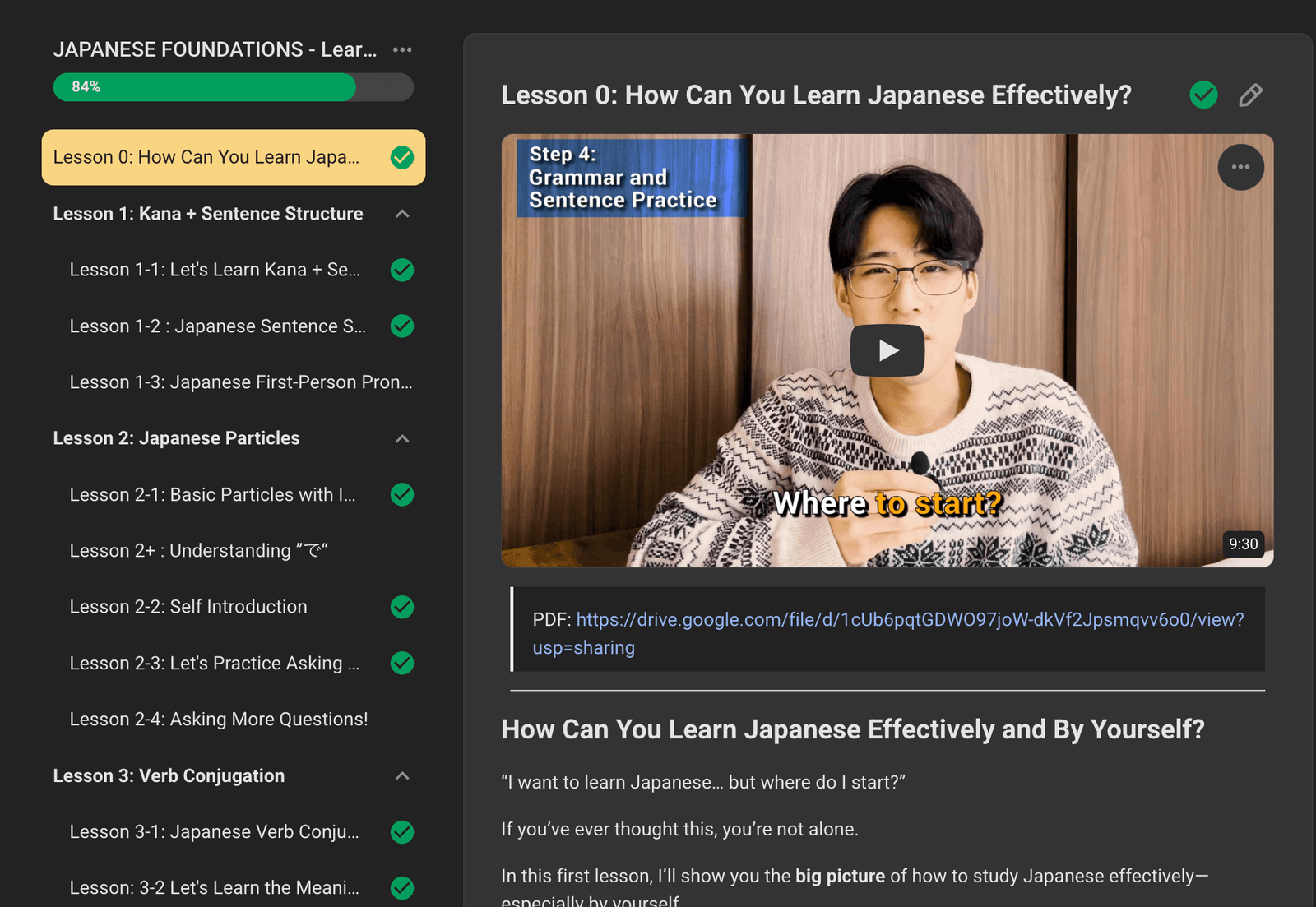
Most beginners quit for the same reason.
They memorize. They don’t understand.
You learn that は is “the topic particle” and が is “the subject particle” — and a week later you still guess. You memorize て-form as a table of endings, and it never sticks.
That isn’t a memory problem. It’s a teaching problem.
Every grammar point starts with a picture.
Not a rule to memorize. An image of what the grammar actually does.
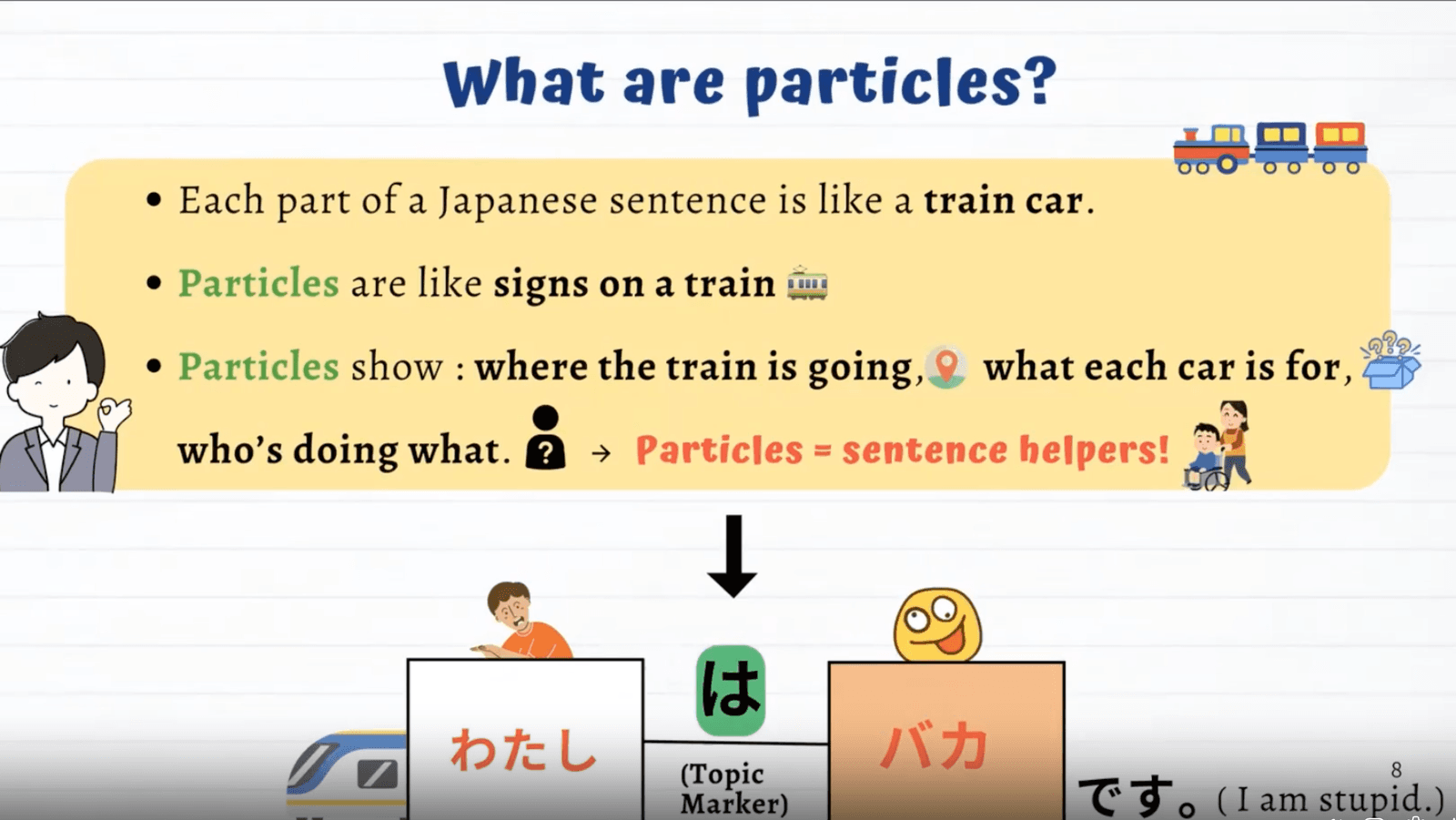
Particles are signs on a train
Each part of a sentence is a train car. Particles are the signs that tell you where the train is going and what each car is for. Once you see it, は and が stop being a coin flip.
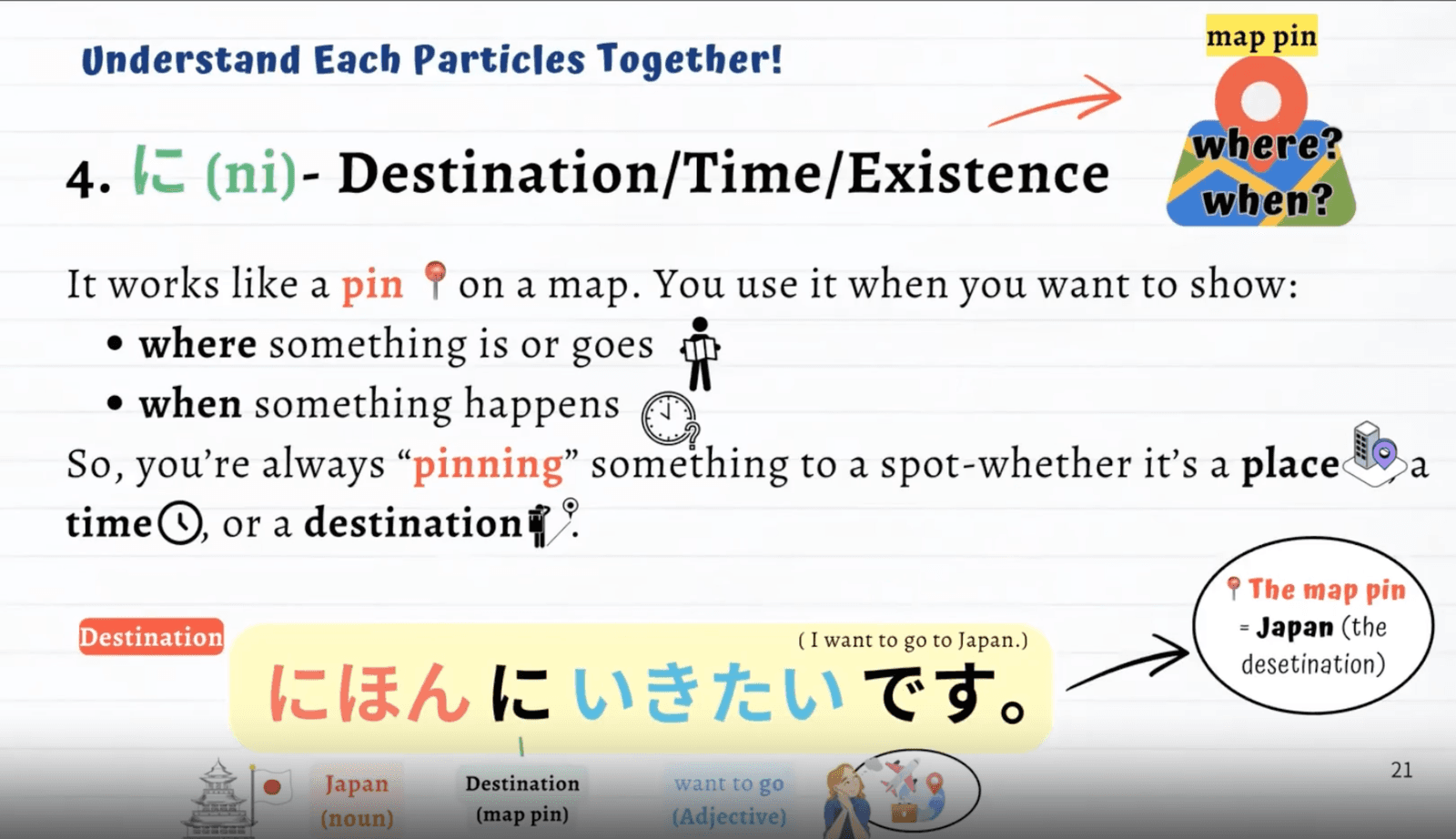
に is a pin on a map
Place, time, destination — it’s always pinning something to a spot. One image covers every use, instead of a list of six rules.
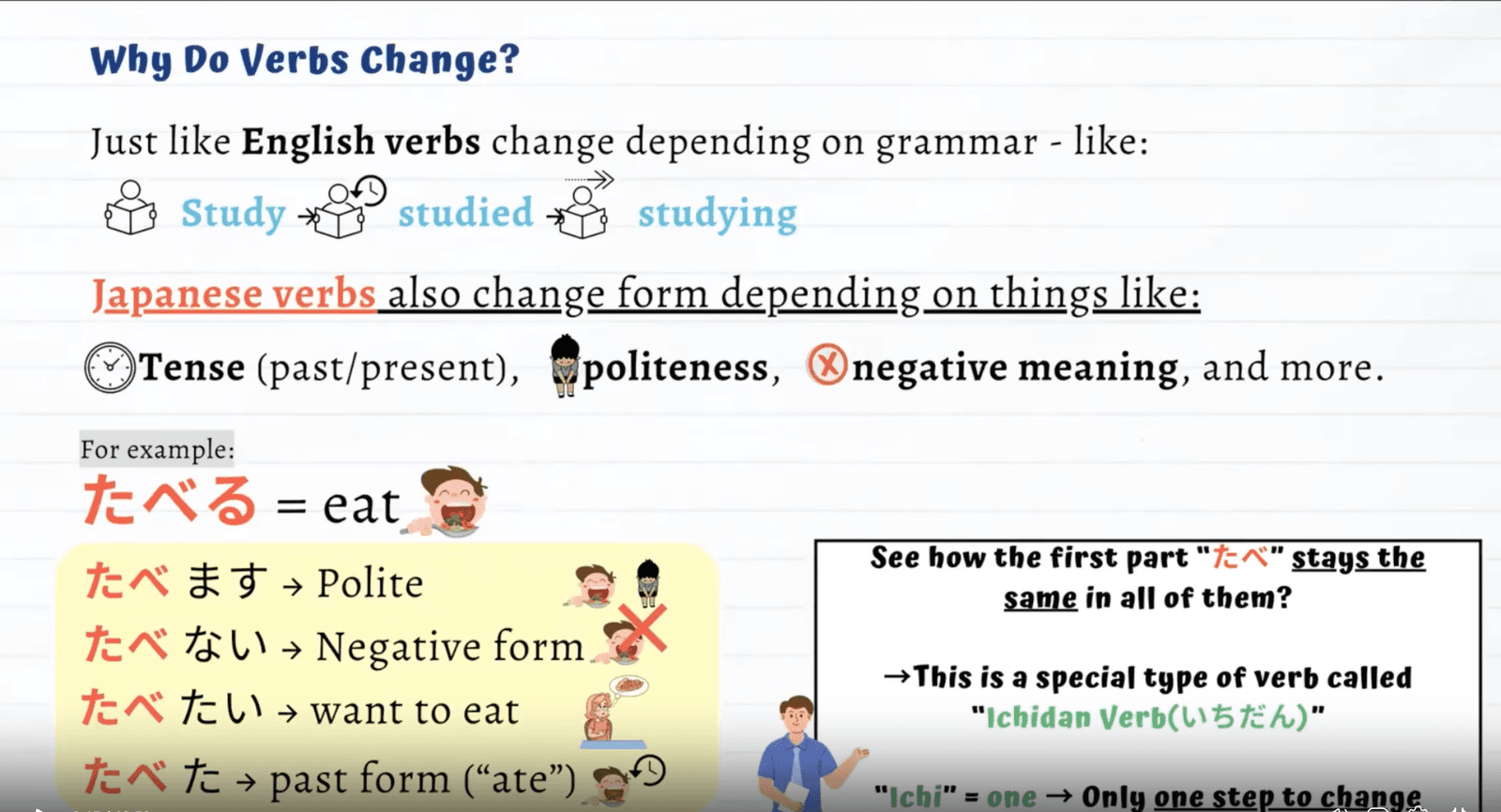
“Ichidan” means one step
たべる → たべます、たべない、たべたい、たべた. The first part never changes. That’s not a coincidence, and once you know why, conjugation stops being a table to memorize.
And the order matters.
You learn past form (Lesson 5) before て-form (Lesson 6) — because if you know the past form, て-form is just た → て and だ → で. Most textbooks make you memorize it from zero. You won’t have to.
By the end, you can build your own sentences.
Not repeat them. Build them.
- Read and write both kana — and know when each one is used
- Introduce yourself and ask people questions back
- Use particles with confidence — は, が, を, に, で and why they differ
- Conjugate verbs across all 5 forms — and know what each form is for
- Describe things with い-adjectives and な-adjectives
- Talk about the past — with verbs and adjectives
- Say what you’re doing right now with て-form and 〜ている
The curriculum
19 video lessons across 7 modules. Open a module to see its lessons.
Lesson 0How Can You Learn Japanese Effectively?Study in a way that actually sticks · 1 lesson
Lesson 1Kana + Sentence StructureRead both alphabets, see how a sentence is built · 3 lessons
- 1-1Let’s Learn Kana + Sentence Structure!
- 1-2Japanese Sentence Structure!
- 1-3Japanese First-Person Pronouns
Lesson 2Japanese ParticlesIntroduce yourself and ask questions back · 5 lessons
- 2-1Basic Particles with Images (Input)
- 2+Understanding「で」
- 2-2Self Introduction
- 2-3Let’s Practice Asking Questions!
- 2-4Asking More Questions!
Lesson 3Verb ConjugationUse all five verb forms, and know what each is for · 2 lessons
- 3-1Japanese Verb Conjugation
- 3-2Let’s Learn the Meaning & Use 5 Forms!
Lesson 4AdjectivesDescribe how things look, feel and taste · 2 lessons
- 4-1Understand Japanese Adjectives (Input)
- 4-2Let’s Use Japanese Adjectives
Lesson 5Past FormTalk about what you did and how it was · 4 lessons
- 5-1Japanese Past Forms (Verbs)
- 5-2Let’s Use Japanese Past Forms (Verbs)
- 5-3Japanese Past Forms (Adjectives)
- 5-4Let’s Use Past Form (Adjective)
Lesson 6て-formSay what you are doing right now · 2 lessons
- 6-1Understand て-Form and 〜ている!
- 6-2Let’s Use て-Form and 〜ている!
You don’t just learn it. You use it.

Every topic has an Input lesson and a Use lesson. You see the image first, then you put it to work — describing a real photo, answering in Japanese, building sentences of your own.
Write it the same day you learn it.
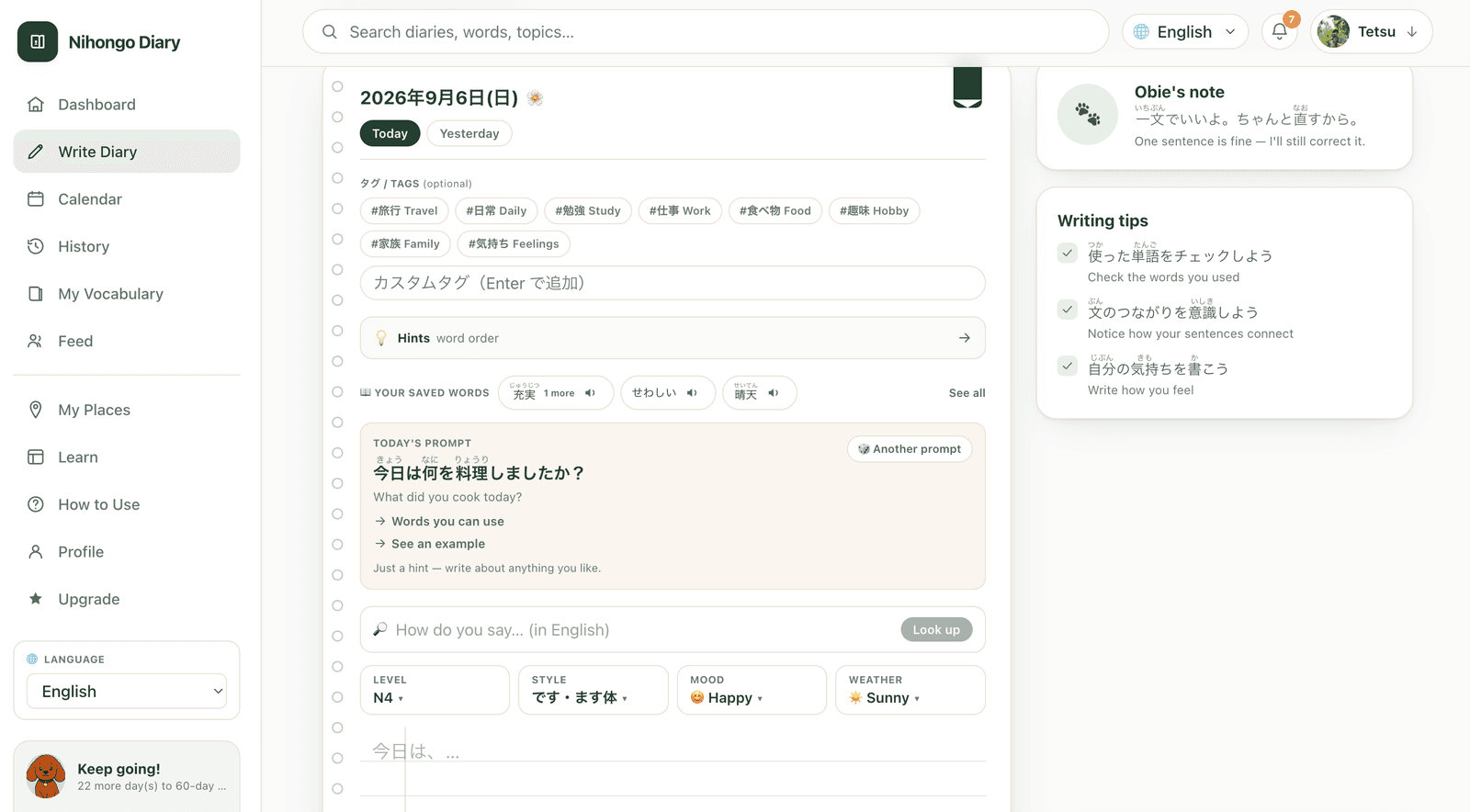
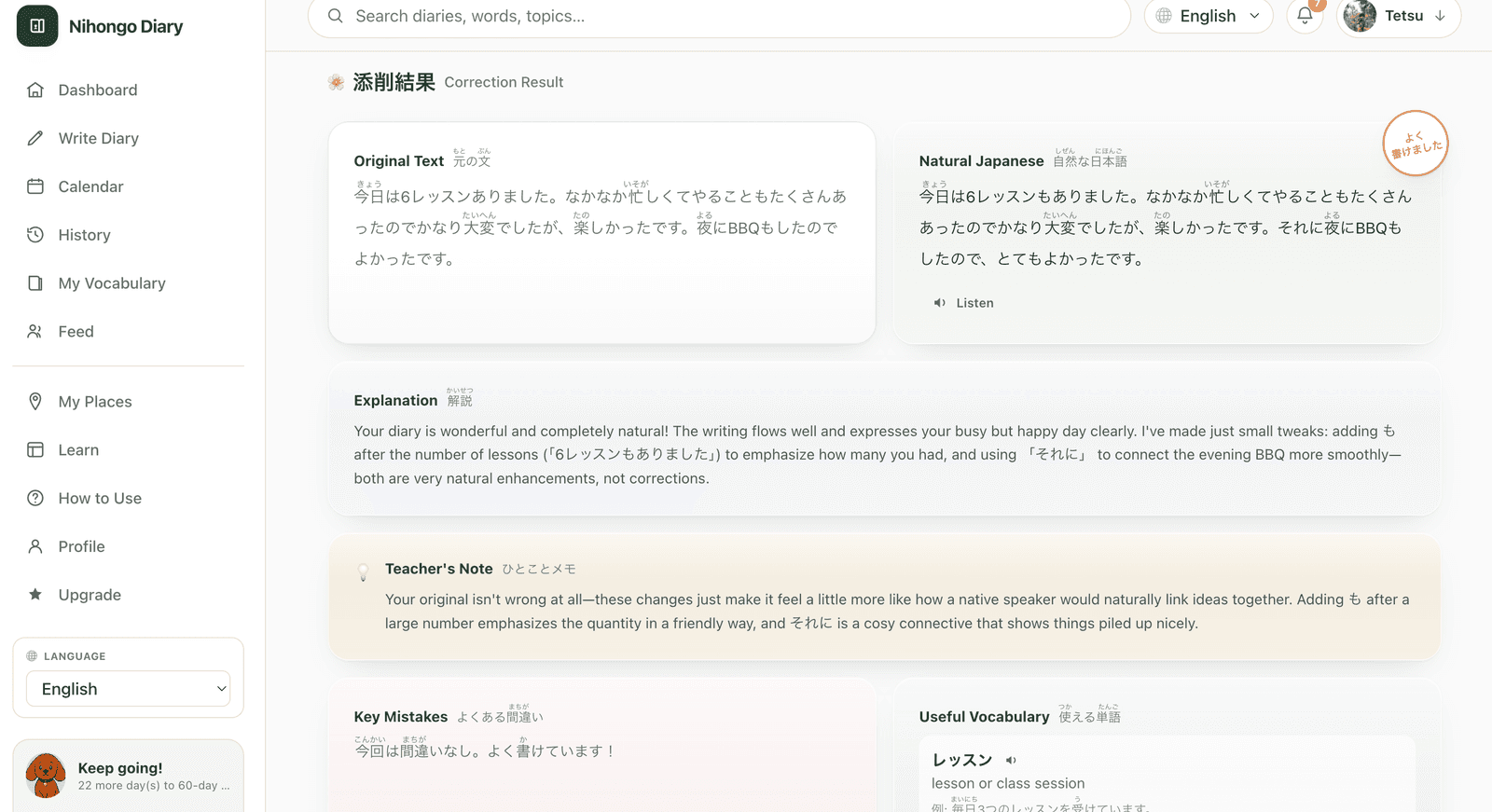
Nihongo Diary is the app I built for exactly this, and it’s free to use. Write a few lines about your day, and get them corrected in seconds, with the natural version beside your own and an explanation in English.
Learn 〜ている in Lesson 6, then use it in tonight’s entry.
Course or Lounge?
The same course is also inside the Lounge. Here’s how the two differ.
| Japanese Foundations | Japanese Lounge | |
|---|---|---|
| Price | $99 one-time | $15 / month |
| The course itself | Included | Included |
| Summary PDFs | Included | — |
| Workbooks | Included | — |
| Weekly prompts | — | Included |
| Live group lessons | — | Included |
| Feedback from Tetsu | — | Included |
| Best if | You want to go at your own pace, alone | You want people alongside you, every week |
Not sure? Start with the course — if it’s not right for you, there’s a full refund within 14 days. You can join the Lounge any time.
This is for you if…
- You’re starting from zero, or you’ve studied before and it never clicked
- You want to understand grammar, not memorize tables
- You want to learn at your own pace, on your own schedule
- You’d rather not join a group or speak in front of others
This is not for you if…
- You want live lessons and group practice — Japanese Lounge is built for that
- You’re already comfortable with て-form and past tense — this would be review

Hi, I’m Tetsu.
I’m a Japanese teacher from Sapporo. I teach on YouTube to around 40,000 learners, run private lessons, and built Nihongo Diary — an app that corrects your Japanese journal entries.
I teach grammar the way I wish it had been taught to me: with a clear image first, then the rules. Not the other way around.
- YouTube subscribers
- 40,000YouTube
subscribers - video lessons
- 19video
lessons
Questions
- Do I need to know any Japanese already?
- No. Lesson 1 starts with the alphabet.
- How long does it take?
- Most learners finish in 6–10 weeks at a few lessons per week. There’s no deadline — go at your pace.
- Is this JLPT N5?
- It covers the grammatical core of N5. It’s designed for using Japanese, not just passing a test, but it maps closely.
- How do I get access after buying?
- You’ll receive an email with your course link within 24 hours of purchase.
- Can I get a refund?
- Yes. If it’s not right for you, email me within 14 days of purchase and I’ll refund you in full — no questions asked. Refunds are processed through Stripe.
- What is Nihongo Diary?
- My app for practicing Japanese by writing. You write a short diary entry, and it’s corrected within seconds with English explanations. It’s free to use, and it’s not part of this purchase — but it’s the fastest way to use what you learn here.
Start building your foundation.
19 lessons. PDFs and workbooks. Yours forever, for $99.
Enrollment isn’t open yet.
$99 one-time · Yours forever · 14-day money-back guarantee